
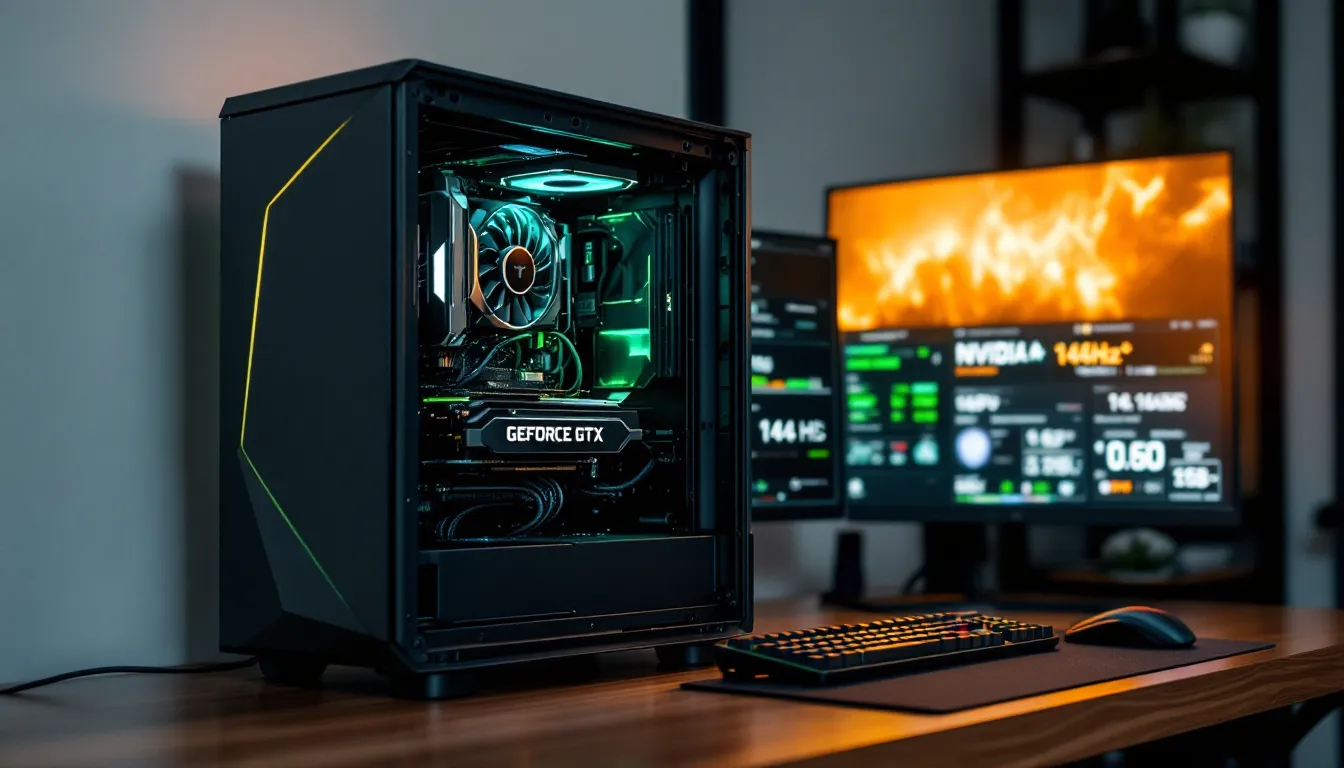

NVIDIA’s GTX line of graphics cards has been the backbone of PC gaming for over a decade, and even though the rise of newer RTX technology, GTX gaming remains surprisingly relevant in 2026. Whether you’re building a budget rig, eyeing competitive esports performance, or upgrading from older hardware, understanding where GTX cards fit in today’s landscape is crucial. This guide cuts through the noise and gives you the real data on GTX gaming, performance benchmarks, platform support, optimization tricks, and whether these legacy cards still deserve a spot in your build. If you’re exploring options for a new gaming setup or considering a GTX login to an online gaming platform, knowing what these cards can actually deliver matters.
Key Takeaways
- GTX gaming remains viable in 2026 for budget-conscious builders, esports players, and anyone prioritizing performance-per-dollar over cutting-edge graphics technology.
- GTX cards excel at 1440p gaming and competitive esports titles without ray tracing, delivering 100+ fps in most non-ray-traced games at a fraction of RTX costs.
- Used GTX 1070 and GTX 1080 Ti units represent exceptional value, outperforming newer budget RTX cards by 2–3x on fps-per-dollar and costing $280–350 versus $500+ for comparable new RTX hardware.
- RTX becomes necessary for 4K gaming with ray tracing and DLSS, while GTX cards suit 1440p builds, budget rigs, and streaming applications with secondary encoding GPUs.
- Keep GTX drivers updated through NVIDIA GeForce Experience, monitor thermal temps below 75°C with regular heatsink cleaning, and consider modest overclocking (50–150 MHz) for 5–10% performance gains using MSI Afterburner.
What Are GTX Graphics Cards?
GTX graphics cards are NVIDIA’s discrete GPUs designed for gaming, content creation, and high-performance computing. The ‘GTX’ designation (GeForce GTX) emerged around 2008 and became synonymous with consumer-level gaming acceleration. Unlike integrated graphics built into processors, GTX cards are dedicated units with their own memory (VRAM), cooling solutions, and processing power.
These cards sit between NVIDIA’s entry-level GT series and the professional Quadro/RTX line. You’ll find GTX variants across multiple price points, from the GTX 1050 (affordable and power-sipping) to the GTX 1080 Ti (still performing admirably at 1440p and even 4K in 2026). The key appeal is accessibility: GTX cards offer solid gaming performance without the premium pricing of modern RTX models.
Each GTX generation comes with a specific architecture (Maxwell, Pascal, Turing) that dictates raw compute capability, memory bandwidth, and power efficiency. These architectural differences matter when you’re shopping for cards or checking compatibility with your current system. The GTX line peaked in consumer adoption around the Pascal generation (GTX 10 series), though newer variants continue production in select markets.
The Evolution of GTX Technology
From GTX 200 Series to Modern Variants
The GTX journey began with the GeForce GTX 200 series in 2008, built on the 65nm process using the G200 GPU core. These were absolute monsters by the standards of the time, the GTX 285 dominated high-end gaming rigs. Fast forward through the Fermi (GTX 400/500), Kepler (GTX 600/700), Maxwell (GTX 750/950/980), Pascal (GTX 1060–1080 Ti), and Turing (GTX 1650–1660 Ti) generations, and you’re looking at a clear progression in efficiency, performance-per-watt, and memory configuration.
The Pascal generation (GTX 10 series, 2016–2017) represents the sweet spot for many gamers in 2026. Cards like the GTX 1080 Ti still crush 1440p gaming at high settings, and even the GTX 1070 remains viable for competitive 1080p play. The Turing generation (GTX 1650, GTX 1660, GTX 1660 Ti, released 2019–2021) brought improved efficiency and some RT Core features (though without the full RTX implementation). These are often the most affordable new-old-stock cards available today.
Key Differences Between GTX Generations
Clock speeds, memory type, and core count evolved significantly across generations. The GTX 960 used GDDR5 memory, while later Turing cards switched to GDDR6 or GDDR6X for faster bandwidth. Older Maxwell and Pascal cards often lack modern connectivity, you’ll find some GTX cards with only DVI or single HDMI output, whereas Turing variants and newer boards include DisplayPort 1.4 and multiple HDMI 2.0 ports.
Architectural shifts also changed texture filtering performance, memory compression efficiency, and power delivery requirements. A GTX 980 Ti consumed 250W: the GTX 1080 Ti also ran at 250W but delivered significantly more performance per watt. Turing-based GTX cards further improved that ratio, though still not matching the efficiency of modern RTX 40-series parts.
Another crucial difference: driver support. NVIDIA continues issuing driver updates for GTX cards, but support windows are finite. Cards from the Kepler era (GTX 600/700) can no longer receive the latest drivers, a consideration if you’re buying old hardware. Pascal and Turing still receive regular updates and will likely continue through 2026 and beyond.
GTX vs. RTX: Understanding the Comparison
Performance Metrics and Real-World Gaming Impact
RTX cards introduced ray tracing and DLSS (Deep Learning Super Sampling), two features that fundamentally changed gaming. Ray tracing simulates realistic lighting by bouncing virtual light rays off surfaces, computationally expensive but visually stunning. GTX cards have zero ray-tracing hardware: they can’t run ray-traced games at playable framerates without serious performance hits.
But, most competitive esports titles, CS2, Valorant, Overwatch 2, don’t use ray tracing. Neither do many popular indie and older AAA games. This is where GTX cards retain massive value. A GTX 1080 Ti delivers 240+ fps in CS2 at 1440p on maximum settings, beating even some modern RTX 3060 cards due to sheer VRAM bandwidth and boost clock speeds.
DLSS is NVIDIA’s AI-powered upscaling technology that renders games at lower resolution internally, then uses AI to reconstruct higher resolution output. GTX cards don’t support DLSS either, this is an RTX-exclusive feature (RTX 20 series and newer). Games relying on DLSS for acceptable performance at high resolutions and settings will run significantly worse on GTX hardware.
Crucially, RTX cards cost substantially more, a new RTX 4060 Ti retails around $500, while used GTX 1080 Ti units still go for $250–350 on the second-hand market. For 1440p gaming without ray tracing, the performance-to-dollar ratio favors GTX cards heavily. Budget-focused builders often find a GTX 1660 Ti ($200–250 used) vastly more practical than stretching for an RTX 4050 (which barely outperforms it anyway).
One often-overlooked metric: memory configuration. The GTX 1080 Ti has 11GB of VRAM, while the RTX 4070 has 12GB. The GTX carries more bandwidth (484 GB/s vs. 432 GB/s), which matters in bandwidth-limited games. Modern AAA titles increasingly demand larger VRAM pools for high-res textures, where RTX has the edge, but for esports and older games, GTX memory is sufficient.
According to Tom’s Hardware benchmarks, GTX 10-series cards still achieve 60+ fps in most 2024–2025 games at 1440p with high (not ultra) settings. RTX gains shine mainly when enabling ray tracing, DLSS, or playing demanding titles like S.T.A.L.K.E.R. 2 or Avatar: Frontiers of Pandora at 4K. For everything else, GTX performance remains genuinely competitive.
Which GPU Is Right for Your Gaming Setup?
Budget Gaming with GTX Cards
If you’re working with a tight budget, GTX cards are often the smartest play. A used GTX 1650 or GTX 960 can handle 1080p gaming at 60 fps across most titles released before 2023. These cards pull 75–120W from the PSU, meaning you can pair them with a modest 450–550W power supply.
For ultra-budget builds ($150–250 GPU spend), consider the GTX 1050 Ti or GTX 1650. Both offer power efficiency, wide driver support, and solid performance in esports titles. They won’t max out Cyberpunk 2077 at 4K, but neither will a $150 RTX 3050 (which is slower, anyway).
The key limitation of budget GTX cards is VRAM. The GTX 1050 and GTX 1650 typically come with 2GB or 4GB configurations. For 1080p gaming, 2GB suffices in most 2024 games, but 4GB provides comfortable overhead. Avoid 1GB variants entirely, they’re relics from the 2010s and will choke on modern textures.
When hunting second-hand GTX cards, prioritize Pascal-generation (GTX 1060, GTX 1070, GTX 1080) or Turing (GTX 1650, GTX 1660, GTX 1660 Ti) over older Maxwell or Kepler variants. Older cards have narrower driver support windows and reduced energy efficiency. A GTX 1070 ($180–220 used) stomps a GTX 960 ($80–120 used) in both absolute performance and future-proofing.
Mid-Range to High-Performance Gaming Options
For 1440p gaming, GTX 1070 Ti, GTX 1080, and GTX 1080 Ti remain the gold standard in used markets. The GTX 1080 Ti especially, released in 2017, still crushes 1440p at 100+ fps in non-ray-traced games. At $280–350 used, it’s a bargain compared to a brand-new RTX 4070 ($599).
If shopping new-old-stock (mint condition, never used), GTX 1660 Ti and GTX 1660 Super are solid picks. They offer better power efficiency than older Pascals, full Turing architecture support, and better driver longevity. Expect $220–280 for these.
For 4K gaming, GTX cards start struggling without compromises. The GTX 1080 Ti achieves 45–60 fps at 4K in older AAA titles (pre-2022) with high (not ultra) settings. Newer, more demanding games like Starfield or Dragon’s Dogma 2 will require lowering settings to 1440p or accepting 30–40 fps.
If you’re aiming for 1440p high-refresh play (144+ Hz), a GTX 1070 or GTX 1080 works brilliantly in esports titles but will drop to 80–100 fps in demanding single-player games. The sweet spot for high-refresh 1440p is a used GTX 1080 Ti or considering the jump to an RTX 4070 Super for ray-traced games with DLSS.
Consider exploring specialized gaming platforms if you’re interested in organized play: platforms like Viper Tech Gaming PC: Ultimate Performance for Competitive Gamers detail how competitive gamers balance GPUs with other components.
GTX Gaming for Specific Platforms and Titles
1440p and 4K Gaming Considerations
1440p is where GTX cards truly shine. At this resolution, a GTX 1070 delivers smooth, stable frame rates across 2024 gaming libraries. Baldur’s Gate 3, Elden Ring, Final Fantasy XVI emulation, all playable at 1440p high settings with a GTX 1080. The key is understanding which games are ray-tracing mandatory and which aren’t. Older titles and many current games (including most MMOs and competitive shooters) don’t require ray tracing, so GTX handles them effortlessly.
When gaming at 1440p, monitor your VRAM usage. Most modern games use 5–7GB of VRAM at high settings. A GTX 1080 Ti with 11GB sits comfortably. A GTX 1070 with 8GB also handles it. GTX cards with 4GB VRAM will experience stuttering or forced texture downgrades.
For 4K gaming, realistic GTX expectations require honesty. A GTX 1080 Ti achieves 50–70 fps at 4K in games released before 2022. Games from 2023 onward? You’re looking at 35–50 fps with settings dialed back to high (not ultra). Enabling ray tracing at 4K on GTX is essentially impossible, framerates crater into unplayable ranges. If 4K + ray tracing matters to you, RTX 4070 and above are required.
Alternatively, 4K gaming at 30 fps is viable for single-player, story-driven games where frame rate matters less. The GTX 1080 Ti can maintain 30 fps stable at 4K with ultra settings in many titles, which is acceptable for narrative experiences.
Esports and Competitive Gaming Performance
This is GTX territory. Competitive esports titles, Counter-Strike 2, Valorant, Overwatch 2, League of Legends, Dota 2, are GPU-light by design. They prioritize network responsiveness and frame consistency over visual fidelity. A GTX 1060 outputs 240+ fps in Valorant at 1080p, while a GTX 1080 Ti sustains 300+ fps.
For competitive play, GTX cards are honestly overkill. Even a GTX 960 hits 144+ fps in most esports titles at 1080p, which is plenty for a 144Hz monitor. The real bottleneck shifts to CPU, RAM, and monitor refresh rate. Pair a GTX 1070 with a mid-range CPU and a 240Hz monitor, and you’ve got a competitive esports rig that’ll compete at high ranks without very costly.
Frame timing and consistency matter more than absolute framerates in esports. GTX cards, especially newer Turing variants, deliver rock-solid performance in these titles. No stutter, no VRAM issues, no weird ray-tracing hiccups, just pure, predictable gaming.
According to TechSpot GPU benchmarking data, GTX 1070 cards average 185 fps in CS2 at 1440p max settings, which is exceptional for competitive play. Even a GTX 1060 6GB variant sustains 120+ fps, more than sufficient for rank climbing without needing an RTX upgrade.
Another angle: streaming and esports production. If you’re running dual-GPU streaming setups (one for gaming, one for encoding), a GTX 1080 on the encode side handles 1080p 60fps streaming with NVIDIA NVENC, while your main RTX card runs the game. SkyTech Gaming PC and similar pre-built specialists often configure multi-GPU systems for streamers, and GTX cards serve secondary roles here excellently.
Optimizing Your GTX GPU for Maximum Performance
Driver Updates and Software Configuration
Keeping drivers current is non-negotiable. NVIDIA releases Game Ready drivers roughly every 2–4 weeks, optimizing performance for new releases and patching bugs. Older GTX cards still receive updates, Pascal and Turing cards get driver attention regularly through 2026. Kepler and Maxwell cards have hit EOL (end of life) for driver support: if you own a GTX 750 or GTX 970, you’re stuck on older driver branches.
Use NVIDIA’s GeForce Experience tool to auto-detect and install drivers. If you’re gaming on Linux, download drivers from NVIDIA’s official site to avoid distribution-specific lag. After updating, some games benefit from a clean installation: uninstall the driver in safe mode, then do a fresh install.
Beyond drivers, NVIDIA Control Panel settings matter. Enable Maximum Performance power management mode if you’re gaming (not battery-powered). Adjust 3D Settings per-game: bump up Texture Filtering Quality (set to High Quality or Maximum) for sharper visuals in older games that benefit from it. Disable VSync if you have a high-refresh monitor and stable framerates, locked 60 fps feels worse than variable 100+ fps once you adapt.
Also worth noting: NVIDIA DLSS is an RTX exclusive, but GTX cards still support FrameView and benchmarking through third-party tools. Monitoring framerate consistency requires overlay software like Afterburner (discussed below) or in-game benchmarks.
If a specific game runs poorly, check the manufacturer’s recommended GPU list. Games like Baldur’s Gate 3 recommend RTX 3060 Ti for recommended specs, but GTX 1080 Ti achieves nearly identical performance. Developers sometimes overstate RTX requirements because DLSS carries no performance penalty, GTX users should interpret ‘RTX recommended’ as ‘this game has ray tracing: GTX can run it without ray tracing.’
Cooling, Overclocking, and Longevity Tips
GTX cards from the Pascal generation onward ship with solid thermal designs. The GTX 1080 Ti, for instance, handles 80–82°C under sustained load without throttling. But, ambient temperature, case airflow, and dust impact thermals significantly. Clean GPU heatsinks every 6–12 months if gaming regularly. Use compressed air to blow dust from fan vents, do this outside or in a garage to avoid spreading dust indoors.
Target temps: 70–75°C is ideal for gaming. Above 80°C and the card starts thermal throttling (reducing clock speeds), dropping your framerate. If your GTX runs hot, consider reseating the cooler with fresh thermal paste or upgrading to an aftermarket cooler. EVGA and other manufacturers sell replacement coolers for older GTX cards, installing one is straightforward and can drop temps 10–15°C.
Overclocking GTX cards is possible and often worthwhile. Using tools like MSI Afterburner (free, Windows/Linux), you can increase core clock and memory clock by 50–150 MHz without risk if temps stay controlled. The gains: 5–10% performance uplift. Example: a GTX 1080 at +100 MHz core clock and +500 MHz memory clock sees roughly 8% higher fps in most games, which translates to 120 fps → 130 fps ranges.
Approach overclocking carefully. Increase core clock first in 25 MHz steps, then run FurMark or Heaven Benchmark for 15 minutes to check stability. If it crashes, decrease clock by 25 MHz. Once stable, push memory clock higher in 100 MHz increments using the same stress-test method. Set a custom fan curve (Afterburner’s Curve tab) to prevent overheating, ramping fans to 70% at 75°C, 85% at 80°C, etc.
Power limits matter too. Older GTX cards have TDP limits you can increase via Afterburner’s power slider (usually capped at +20% max). Pushing harder requires quality PSU headroom: ensure your PSU has 50W+ buffer above your system’s calculated draw.
Longevity-wise, GTX cards typically last 5–7 years of heavy gaming without failure. Capacitors degrade slowly, but NVIDIA’s Pascal and Turing designs are stable. Keep them cool, avoid dust, don’t push ridiculous overclocks, and they’ll outlive their practical gaming relevance. Many gamers still rock GTX 970s and GTX 1070s from 2015–2016 without issues.
Also, consider Discover What’s New in Gaming Technology: Insights from Jogametech for emerging cooling solutions and thermal management trends. Modern paste formulations and bracket designs continue improving, and staying informed helps keep your GTX investment running cool and stable.
Is GTX Gaming Still Viable in 2026?
Absolutely. GTX gaming remains a legitimate, cost-effective choice in 2026 for specific use cases, and it’s worth being honest about when it shines vs. when RTX makes sense.
GTX wins in these scenarios:
Esports competitive gaming (any title), Frame rates are abundant, cost is minimal, and older drivers are irrelevant because esports games are static and stable.
1440p high-refresh (100–144Hz) gaming in non-ray-traced titles. A GTX 1080 Ti is still the best bang for buck.
Budget builds where RTX pricing forces corner-cutting elsewhere. A $400 rig with a GTX 1070 and a solid CPU outperforms a $400 rig with RTX 3050 and weaker CPU in most cases.
Second-hand purchases with strong value per dollar. Used GTX 1080 Ti cards represent absurd value at $280–350 compared to new RTX 4060 Ti at $500+.
Older, beloved games that’ll never see ray-tracing updates (Skyrim modded heavily, emulated PS3/360 games, older MMOs, roguelikes, strategy games).
Streaming on budget constraints. A used GTX 1070 on an encode card is genuinely practical.
RTX makes more sense if:
You’re chasing 4K with high/ultra settings. Ray tracing becomes viable at RTX 4070 and higher, and DLSS is a game-changer for framerate stability.
Future-proofing matters. NVIDIA is transitioning away from GTX entirely: RTX is where new game optimization targets sit.
You’re playing heavy 2024–2025 AAA titles that aggressively use ray tracing and DLSS. Alan Wake 2, Cyberpunk 2077 with RT Overdrive, S.T.A.L.K.E.R. 2, these are better on RTX.
You’re building a streamer rig or professional workstation where CUDA compute and driver support longevity matter.
The verdict: GTX gaming is viable in 2026, but it’s not universal. For budget gamers, esports players, and anyone chasing value, GTX cards are the smart choice. For cutting-edge graphics and future-proofing, RTX is necessary. The real question isn’t whether GTX works, it’s what you prioritize: cost, performance, visual fidelity, or longevity. Honest assessment of your actual needs beats bandwagon buying every time.
According to Hardware Times recent market analysis, second-hand GTX 1070 Ti and GTX 1080 Ti cards currently represent the highest value-to-performance ratio available in the used GPU market, outperforming new budget RTX cards on raw gaming fps per dollar by 2–3x.
Conclusion
GTX gaming in 2026 is less about whether it’s ‘good’ and more about whether it fits your specific goals. These cards remain excellent performers for esports, 1440p gaming, and budget-conscious builds. The used market is flooded with capable GTX 1070 and GTX 1080 Ti units that outperform newer budget RTX offerings at lower prices.
Driver support continues for Pascal and Turing GTX cards, and optimization keeps improving. But, as ray-tracing adoption accelerates and game engines increasingly assume DLSS availability, RTX inevitably becomes more practical for newer AAA titles.
The bottom line: if you’re gaming at 1440p or below, prioritizing esports, or hunting second-hand deals, a GTX card is a smart, practical choice. If you’re targeting 4K, chasing cutting-edge graphics, or want guaranteed driver support through the 2030s, RTX is the safer pick. Neither choice is wrong, it depends entirely on your budget, your monitor, and the games you actually play. Do the math for your specific setup, and you’ll find the answer.